
- Home
- »
- Next Generation Technologies
- »
-
E-Textiles Market Size, Growth Report, 2026-2033GVR Report cover

E-Textiles Market (2026 - 2033)
Size, Share & Trends Analysis Report By Product (Smart Clothing, Smart Footwear, Wearable Accessories, Protective Wear), By Component, By Application, By End User, By Region, And Segment Forecasts
Market Size, 2025
$3.2BMarket Estimate, 2026
$3.8BMarket Forecast, 2033
$13.5BCAGR, 2026–2033
20.0%E-Textiles Market Summary
The global e-textiles market size was valued at USD 3.2 billion in 2025 and is projected to grow from USD 3.8 billion in 2026 to USD 13.5 billion by 2033, at a CAGR of 20.0% from 2026 to 2033. The North America market dominated with the largest revenue share in 2025. The market is expected to record growth owing to technological advancements and innovations in wearable technology and intelligent clothing by expert wearable computing designers.
Key Market Trends & Insights
- By product: The smart clothing segment dominated the market in 2025.
- By component: The sensors segment held the largest revenue share in 2025.
- By application: The sports & fitness segment dominated the market with the largest revenue share in 2025.
- By end user: The consumer segment held the largest market share in 2025.
Regional Highlights
- Largest regional market: North America (2025)
- Fastest-growing regional market: Asia Pacific (highest CAGR, 2026-2033)
Market Size & Forecast
- Market size in 2025: USD 3.2 Billion
- Estimated market size in 2026: USD 3.8 Billion
- Projected market size by 2033: USD 13.5 Billion
- CAGR (2026-2033): 20.0%
Three ways to get this report
Buy it, customize it, or ask a question.Ask an Analyst
A direct answer, usually in 1 working day
- AccessReport author, directly
- Reply timeWithin 1 working day
- No sales callDirect answer only
- FormatEmail reply
- CostFree, no cost
Get the Full Report
What the study covers
- FormatsPDF · Excel · Dashboard
- Timeline2026–2033 annual, 2025 base
- Coverage20+ countries, 5 regions
- Companies10+ key players profiled
Customize the Report
20% free customization
- IncludeCountries, segments, points
- TailorTo your product definition
- ExtendDeeper competitor detail
- OrA fully bespoke study
- Turnaround5–10 working days
The market is witnessing steady growth driven by the increasing adoption of wearable electronics, rising demand for smart healthcare solutions, and growing consumer preference for connected apparel. Electronic textiles (e-textiles) are fabrics integrated with electronic components such as conductive fibers, sensors, batteries, and communication modules to provide functionalities including sensing, data transmission, energy harvesting, and temperature regulation while maintaining the flexibility of conventional textiles. Expanding application scope across healthcare, sports and fitness, military and defense, industrial safety, and fashion industries is further supporting market growth.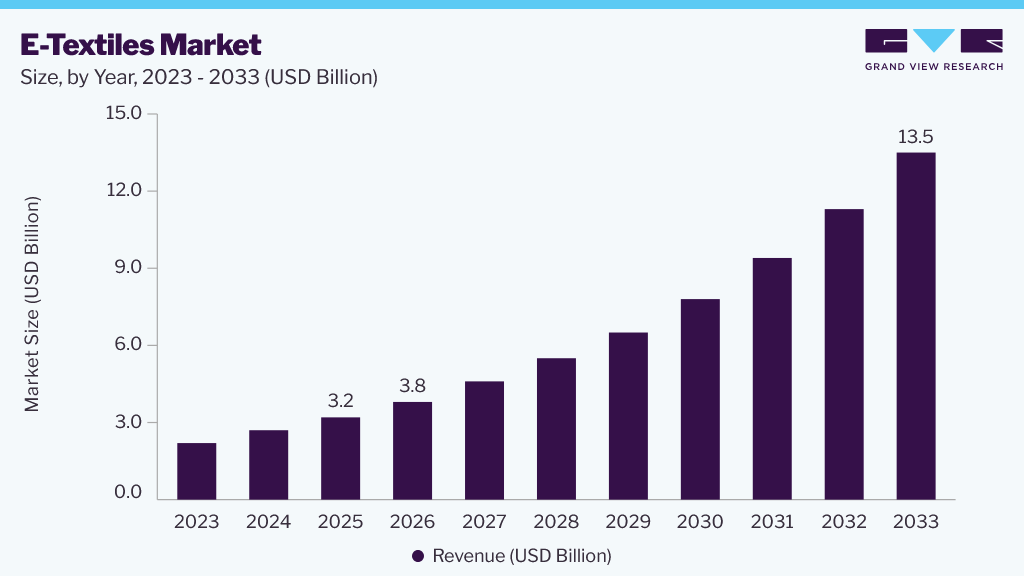 Source: Grand View Research, IR Documents, Primary Interviews, Paid DatabasesTo learn more about this report,
 Download Free Sample Report
 Continuous advancements in conductive fibers, flexible electronics, and smart materials are accelerating product innovation in the market. Manufacturers are increasingly focusing on developing stretchable conductive fibers, flexible sensors, photovoltaic cells, and supercapacitors to improve the performance and durability of e-textiles. Growing investments in research and development are also enabling the commercialization of waterproof, breathable, and washable smart fabrics with enhanced comfort, durability, and energy-harvesting capabilities.
E-textiles are used in a broad range of products, including smart clothing, medical bandages, surgical drapes, compression garments, and bed linen. These textiles can monitor physiological parameters, regulate temperature, enable wireless communication, emit light, and support diagnostic and therapeutic functions. Their expanding capabilities are driving adoption in remote patient monitoring, rehabilitation, fitness tracking, occupational safety, and interactive consumer apparel, creating significant growth opportunities across multiple industries.
Despite favorable growth prospects, the market faces challenges including limited large-scale manufacturing capacity, high production costs, and the complexity of integrating electronic components into textile substrates. The lack of standardized manufacturing processes, uncertainty in large-volume commercial orders, and intellectual property barriers associated with extensive patent portfolios continue to restrain market expansion. In addition, the commercialization of e-textiles requires multidisciplinary expertise and significant investments in advanced manufacturing technologies, posing challenges for new market entrants.
Analyst Perspective
The e-textiles market is witnessing strong growth, driven by rapid advancements in smart wearable technologies, conductive materials, flexible electronics, and fabric-based sensor systems. Rising demand for real-time physiological and environmental monitoring across healthcare, sports and fitness, industrial workwear, and military applications is accelerating the adoption of smart textile solutions. Technological advancements such as highly conductive fibers, washable electronic components, energy-harvesting capabilities, and miniaturized sensors are significantly enhancing the performance, durability, and usability of e-textiles. In addition, increasing reliability and declining costs of flexible electronics are supporting broader commercialization and integration into mainstream textile products. The scope of e-textiles is expected to expand beyond niche applications into large-scale use cases across consumer apparel, healthcare monitoring systems, industrial safety garments, and defense uniforms. This transition is likely to unlock substantial long-term growth opportunities for market participants across the value chain.
Product Insights
The smart clothing segment accounted for the largest revenue share in 2025 and is expected to maintain its dominance throughout the forecast period, driven by the wide usage in sports and fitness, healthcare, wellness, and wearable lifestyle applications. With the help of sensors sewn into clothes, smart clothing helps to track various physiological signals, postures, movements, and performance of athletes while providing a more comfortable wearing experience in comparison with existing wearables. Ongoing improvements in flexible electronics, conductive fabrics, washable sensors, and wireless capabilities are enhancing the functionality and durability of smart clothing and helping to commercialize it at the consumer and industrial levels. For instance, in July 2024, researchers at The Hong Kong Polytechnic University developed iActive, an intelligent sportswear system incorporating electrically activated, nature-inspired moisture-management technology. The smart textile features artificial sweat glands and a root-like liquid transport system to dissipate sweat and improve thermal comfort during physical activity.
The protective wear segment is projected to register the fastest CAGR during the forecast period, owing to the rising need for intelligent Personal Protective Equipment (PPE). With the help of smart garments embedded with conductive materials and physiological and environmental sensing technology, it is possible to track the health status of workers, their exposure to harmful gases, body temperature, and physical fatigue in real time, thus enhancing the safety and effectiveness of operations. Increased expenditure on the development of smart PPE and wearable safety devices is predicted to fuel market growth. For instance, in April 2026, Covestro AG, in collaboration with FILK Freiberg Institute GmbH and OUT e.V., developed a flexible, conductive polymer-based smart textile platform that enables the integration of sensors and electronic components directly into fabrics, eliminating the need for conventional wiring. The technology is designed for applications in healthcare wearables, protective clothing, sportswear, and other functional textile applications.
Component Insights
The sensors segment accounted for the largest revenue share in 2025 and is expected to maintain its dominance throughout the forecast period. The sensors form the basic functional unit of commercially available e-textile products that facilitate continuous tracking of physiological parameters, including heart rate, breathing, body temperature, muscle movements, and posture. The widespread use of sensors in smart textiles, medical textiles, sports clothing, and industrial protective clothing has significantly enhanced the functionalities of wearable textile products. Developments in flexible, stretchable, and washable sensors will continue to enhance the performance and longevity of smart textiles. For instance, in March 2025, researchers at the University of Cambridge developed washable smart pajamas embedded with textile-based sensors that monitor breathing patterns and detect sleep disorders, including sleep apnea, in home environments. The system enables continuous sleep-state classification using machine learning, highlighting the growing role of advanced sensing technologies in e-textiles for healthcare applications.
The conductive fibers & yarns segment is projected to register the fastest CAGR during the forecast period, owing to the rising trend toward integrating electronic capabilities into fabrics while ensuring product flexibility, durability, and washability. The conductive yarn is the heart of electronic fabrics by allowing the transfer of electricity and performing other operations without compromising the comfort of the material. Rising demand for scalable manufacturing methods and standardized conductive materials is expected to boost the commercialization of electronic textiles across various industries. For instance, in July 2025, the Global Electronics Association published IPC-8911, the first-of-its-kind global standard for conductive yarns used in e-textiles. The standard establishes requirements for classification, designation, qualification, and performance testing, enabling consistent evaluation of conductivity, durability, and environmental resistance across conductive yarn materials.
Application Insights
The sports & fitness segment accounted for the largest revenue share in 2025 and is expected to maintain its dominance throughout the forecast period. The growing popularity of connected sportswear equipped with features such as heart rate detection, muscle function analysis, body temperature regulation, postural correction, and athletic performance measurement has become a key driver of market growth. Ongoing innovations in the field of flexible electronics, conductive fabrics, and sensor technology have helped create light, breathable, and washable smart clothing that ensures real-time physiological data collection without compromising the comfort of wearers. In addition, increased consumer awareness related to fitness tracking, injury prevention, and personalized performance analytics has contributed to the proliferation of sports clothing based on e-textile technology. For instance, in January 2025, researchers led by the University of Southampton, in collaboration with UWE Bristol and other UK universities, developed SWEET (Smart, Wearable, and Eco-friendly Electronic Textiles), a biodegradable, fully inkjet-printed e-textile platform capable of monitoring heart rate and temperature for healthcare and performance sportswear applications.
The healthcare & medical segment is projected to register the fastest CAGR during the forecast period, owing to increasing demand for continuous patient monitoring, remote healthcare, rehabilitation, and chronic disease management. With the help of smart textiles embedded with flexible sensors, it is now possible to monitor vital signs such as electrocardiogram (ECG) signals, respiration rate, and muscle and body movements. Increasing investment in digital healthcare, telemedicine, and wearable medical technology is expected to continue the momentum of adoption in hospitals and home healthcare. For instance, in May 2025, researchers from ETH Zurich reported the development of SonoTextiles, an acoustic-based smart textile platform capable of continuous respiratory rate monitoring, muscle activity sensing, tactile sensing, and hand gesture recognition for wearable healthcare applications.
End User Insight
The consumer segment accounted for the largest revenue share in 2025 and is expected to maintain its dominance throughout the forecast period. The inclusion of wearable clothing, smart clothing, fitness devices, fashion accessories, and similar items has played a major role in driving segment growth. Customers are now looking for clothing that helps track their physical activities, heart rate, posture, sleep patterns, and even their overall well-being while remaining comfortable and stylish. Advances in technology regarding washable electronics and flexible sensors have propelled their commercial use. For instance, in December 2025, the Ministry of Textiles announced that 24 start-ups had been approved under the Grant for Research & Entrepreneurship across Aspiring Innovators in Technical Textiles (GREAT) scheme of the National Technical Textiles Mission. The approved projects include innovations in graphene-based smart textiles, energy-harvesting fabrics, shape-memory wearable technologies for healthcare, and other advanced functional textile solutions.
The healthcare segment is projected to register the fastest CAGR during the forecast period, owing to rising demand for patient monitoring, telemedicine, rehabilitation, and chronic disease management. The use of smart medical textiles with textile sensors helps monitor vital signs in real time while making patients more comfortable than regular wearables. The rise in the adoption of e-textiles within the digital healthcare landscape, along with increased investments in smart medical wearables, is likely to contribute to the continued growth of this segment. For instance, in January 2025, the Ministry of Science and Technology announced that researchers at JNCASR developed a stretchable sensing device based on a silver wire network that detects mechanical strain and mimics pain perception, paving the way for future smart wearable systems capable of monitoring physiological stress.
Regional Insights
North America e-textiles market accounted for the largest revenue share in 2025. The region benefits from an established network of wearable tech products, significant funding for smart textiles R&D, and the presence of top electronics, medical, and military corporations. Growing adoption of connected sports clothing, monitoring apparel for medicine, military smart wearables, and industrial safety apparel is expected to contribute to the growth of the market. Moreover, partnerships between research organizations and industries contribute to the commercialization of new e-textile technologies.
Asia Pacific E-Textiles Market Trends
Asia Pacific is projected to register the fastest CAGR during the forecast period, owing to the fast-growing textile manufacturing industry, growing electronics manufacturing, and increasing government funding for smart textiles research and development. Countries such as China, Japan, South Korea, and India are making significant investments in wearable electronics, conductive fibers, smart textiles, and flexible electronics. The existence of a strong textile manufacturing sector, along with the increasing demand for healthcare wearables, smart sportswear, and industrial protective gear, is expected to further fuel regional growth. For instance, in December 2025, the Government of India, under the National Technical Textiles Mission (NTTM), highlighted its support for research and innovation in smart textiles through approved R&D projects focused on conductive fibers, wearable electronics, photonic fabrics, perovskite solar textiles, antenna-integrated materials, and next-generation piezoelectric/flexoelectric fabrics.
Key E-Textile Company Insights
The major players in the e-textiles industry are concentrating on the development of conductive fibers, textiles embedded with sensors, flexible electronics, and smart fabrics. Collaborations, product innovations, and investments in areas such as wearable healthcare devices, connected sports apparels, and intelligent protective wear are aiding the companies to grow commercially as well as enhance the quality of their e-textiles.
Key E-Textile Companies
The following key companies have been profiled for this study on the e-textiles market.
-
DuPont de Nemours, Inc.
-
Textronics, Inc.
-
Myant Inc.
-
Schoeller Textil AG
-
Interactive Wear AG
-
AIQ Smart Clothing Inc.
-
Clothing+ Oy
-
Ohmatex ApS
-
Toray Industries, Inc.
-
Bekaert NV
Recent Developments
-
In November 2025, Carré Technologies (Hexoskin) announced that its smart biometric shirt, the Hexoskin Medical System, received FDA 510(k) clearance for continuous long-term ECG, respiratory, and activity monitoring in ambulatory patients.
-
In June 2025, French geolocation-tech company TRAAK acquired Chronolife, maker of a CE Class IIa-certified connected e-textile T-shirt that tracks ECG, respiration, temperature, and pulmonary impedance.
-
In May 2025, DuPont Personal Protection and Epicore Biosystems announced a collaboration combining DuPont's protective garment expertise with Epicore's "Connected Hydration" sweat-sensing wearable technology, aimed at real-time hydration/heat-stress monitoring for industrial workers
E-Textiles Market Report Scope
Report Attribute
Details
Market size in 2025
USD 3.2 billion
Estimated market size in 2026
USD 3.8 billion
Projected market size by 2033
USD 13.5 billion
Growth rate
CAGR of 20.0% from 2026 to 2033
Base year for estimation
2025
Actual data
2021 - 2024
Forecast period
2026 - 2033
Quantitative units
Revenue in USD billion, and CAGR from 2026 to 2033
Report coverage
Revenue forecast, company ranking, competitive landscape, growth factors, and trends
Segments covered
Product, Component, Application, End user, Region
Regional scope
North America; Europe; Asia Pacific; Latin America; Middle East & Africa
Country scope
U.S.: Canada; Mexico; UK: Germany; France; Italy; Spain; Japan; China; India: Australia; South Korea; Brazil; Argentina; South Africa; Saudi Arabia; UAE
Key companies profiled
DuPont de Nemours, Inc.; Textronics, Inc.; Myant Inc.; Schoeller Textil AG; Interactive Wear AG; AIQ Smart Clothing Inc.; Clothing+ Oy; Ohmatex ApS; Toray Industries, Inc.; Bekaert NV
Customization scope
Free report customization (equivalent to up to 8 analyst-days) with purchase. Addition or alteration to country, regional & segment scope.
Pricing and purchase options
Avail of customized purchase options to meet your exact research needs. Explore purchase options
Global E-Textiles Market Report Segmentation
This report forecasts revenue growth at global, regional, and country levels and provides an analysis of the latest industry trends and opportunities in each of the sub-segments from 2021 to 2033. For the purpose of this study, Grand View Research has segmented the global e-textiles market report based on product, component, application, end user, and region:
-
Product Outlook (Revenue, USD Billion, 2021 - 2033)
-
Smart Clothing
-
Smart Footwear
-
Wearable Accessories
-
Protective Wear
-
-
Component Outlook (Revenue, USD Billion, 2021 - 2033)
-
Sensors
-
Conductive Fibers & Yarns
-
Batteries & Power Sources
-
Communication Modules
-
Others
-
-
Application Outlook (Revenue, USD Billion, 2021 - 2033)
-
Sports & Fitness
-
Healthcare & Medical
-
Military & Defense
-
Industrial Safety
-
Fashion & Entertainment
-
-
End User Outlook (Revenue, USD Billion, 2021 - 2033)
-
Consumer
-
Healthcare
-
Military & Defense
-
Industrial
-
Commercial
-
-
Regional Outlook (Revenue, USD Billion, 2021 - 2033)
-
North America
-
Canada
-
Mexico
-
-
Europe
-
UK
-
Germany
-
France
-
Italy
-
Spain
-
-
Asia Pacific
-
Japan
-
China
-
India
-
Australia
-
South Korea
-
-
Latin America
-
Brazil
-
Argentina
-
-
Middle East & Africa
-
Saudi Arabia
-
UAE
-
South Africa
-
-
Frequently Asked Questions About This Report
The global E-Textiles market size was valued at USD 3.2 billion in 2025 and is estimated at USD 3.8 billion for 2026
The global E-Textiles market is expected to grow at a CAGR of 20.0% from 2026 to 2033, reaching USD 13.5 billion
Asia Pacific regional market dominated with the largest revenue share in 2025.
The smart clothing segment accounted for the largest revenue share in 2025
Key players in the market DuPont de Nemours, Inc., Textronics, Inc., Myant Inc., Schoeller Textil AG, Interactive Wear AG, AIQ Smart Clothing Inc., Clothing+ Oy, Ohmatex ApS, Toray Industries, Inc., Bekaert NV, Ltd., and others.
About the Author(s)
Next Generation Technologies Research Team
Technology · Next Generation TechnologiesThis report was authored by the next generation technologies research team at Grand View Research - comprising two research analysts, one senior research analyst, and one industry expert - with specialized expertise in the next generation technologies segment of the technology industry. All findings are based on proprietary technology databases, executive interviews, and regulatory analysis, subject to internal peer review prior to publication.
Last Updated:
Speak to Analyst

Customize this report to your needs - add regions, segments, or data points, with 20% free customization.
Or view our licence options:


ISO 9001:2015 & 27001:2022 Certified
We are GDPR and CCPA compliant! Your transaction & personal information is safe and secure. For more details, please read our privacy policy.


